
From Intel's 'iMBOs' to a ping-pong table at Google
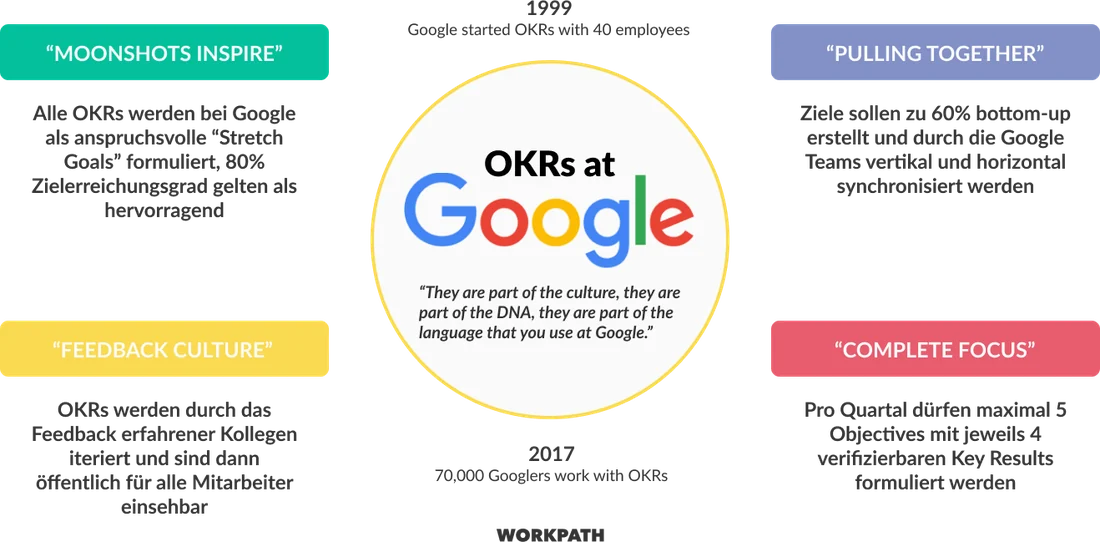
Objectives and Key Results traces its own lineage, by its promoters' own account, to Intel chief executive Andy Grove, who outlined a goal-setting method in his book High Output Management. John Doerr's own OKR resource, as retrieved on 16 September 2026, says Grove called his version 'iMBOs,' evolving Peter Drucker's older 'Management by Objectives,' before Doerr coined the term OKRs and, having learned the method at Intel, introduced it to Google's founders — that site dates the meeting to 1999, held, it says, at 'a ping-pong table that served as a boardroom.' Google's own internal re:Work guide describes the same handoff but places it 'in early 2000' — the two accounts, both from parties close to the story, do not agree on the year. What both describe consistently is the structure: an Objective is 'what is to be achieved,' ideally inspirational, and Key Results 'benchmark and monitor how we get to the Objective,' meant to be specific and time-bound. Doerr's site notes OKRs differ from the older MBOs by running quarterly rather than annually and by being 'divorced from compensation.'
How Google says it runs the cadence
Google's own guide describes setting OKRs at both an annual and a quarterly cadence, then holding company-wide meetings to share and grade them on a 0-to-1.0 scale. It states a deliberate target: a score of '0.6 to 0.7' is the 'sweet spot,' treating full attainment as a sign a goal was not ambitious enough. The framework is built to reward ambition even when a goal is missed, at least in principle, which is also why keeping scores away from compensation matters to the design.
A vendor's evidence for its own method
Google's guide asserts, without naming a study, sample or method, that 'committing to a goal can help improve employee performance' and that 'setting challenging and specific goals can further enhance employee engagement,' and separately cites Sears applying OKRs to 20,000 employees with 'positive impacts on bottom-line sales.' None of that is described with enough detail to evaluate as evidence: no citation, no measured comparison, no account of what else changed at the same time. It is Google's own claim about its own practice, not an independently verified result, and this draft found no peer-reviewed study to set alongside it. A tool that turns the 0-to-1.0 grading into a dashboard risks the exact drift the 'divorced from compensation' principle warns against: a number visible to a manager tends to get used in a review, whatever the framework intended.
- Is the scoring visible to anyone who sets compensation or ratings, whatever the tool's settings claim?
- Are the Key Results actually measurable, or restated tasks wearing a number?
- What happens when a team scores consistently near 1.0 — is the target raised, or left where it is?
OKRs are a specific, named structure with a traceable if disputed ancestry. The evidence for their effect on performance, as presented by the framework's own promoters, is an internal claim rather than a tested result — worth noting before a scorecard becomes part of someone's review.
Sources & reading trail
Defines Objectives and Key Results, credits Andy Grove and John Doerr, and dates the introduction to Google to 1999.
Source published: Not established · Retrieved: 16 September 2026
Describes Google's own OKR cadence and grading scale, dates the introduction to 'early 2000,' and cites unnamed research and a Sears case as evidence.
Source published: Not established · Retrieved: 16 September 2026
Announcements and papers establish the record; the friction reading and the adoption questions are Productivity Atlas editorial analysis. This retrospective draft does not imply the site published on the event date.