
Seventeen people, three days, four values
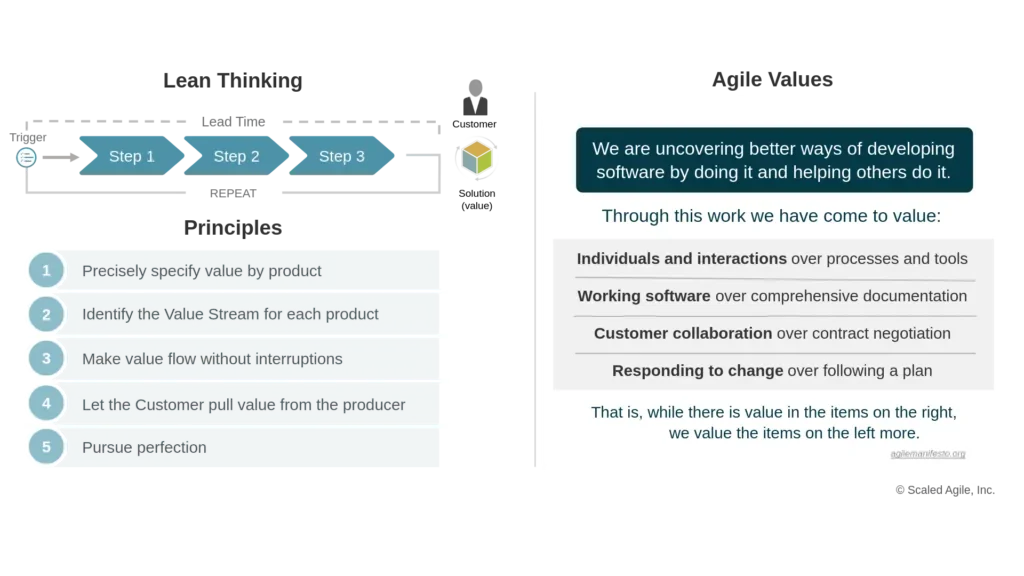
The Agile Manifesto is dated to a specific meeting: the document's own history page says seventeen people met at 'The Lodge at Snowbird ski resort in the Wasatch mountains of Utah' from 11 to 13 February 2001, representing Extreme Programming, Scrum, DSDM, Adaptive Software Development, Crystal and Feature-Driven Development. The meeting grew out of an earlier gathering of Extreme Programming advocates at Rogue River Lodge, Oregon, in spring 2000; Bob Martin proposed the wider Snowbird meeting by email that September. The result, the manifesto itself states, is four preferences, not four rules: 'Individuals and interactions over processes and tools,' 'Working software over comprehensive documentation,' 'Customer collaboration over contract negotiation,' and 'Responding to change over following a plan' — with the document explicit that 'while there is value in the items on the right, we value the items on the left more.'
Twelve principles for software teams specifically
The twelve principles that accompany the values are written for people building software, not for work generally: 'Working software is the primary measure of progress,' delivered 'frequently, from a couple of weeks to a couple of months,' with 'business people and developers' working 'together daily throughout the project.' Two principles describe a discipline rather than a tool: 'the best architectures, requirements, and designs emerge from self-organizing teams,' and at 'regular intervals, the team reflects on how to become more effective, then tunes and adjusts its behavior accordingly.' Neither document specifies who runs that reflection, how often beyond 'regular,' or what a self-organizing team does when it disagrees.
What the document never mentions
Neither the values nor the twelve principles use the words 'sprint,' 'story point,' 'burndown chart,' 'velocity' or 'certification.' Those are additions from specific methodologies — Scrum among them, one of the traditions represented at Snowbird — and from the software industry that grew up around them. A tool that tracks velocity or renders a burndown chart is automating a specific practice invented later, not something this document asked for; the manifesto's own text asks only for working software, frequent delivery, daily collaboration, and regular reflection, leaving the mechanism for each team to choose.
- Which of the four values is the tool actually optimising for, and which is it quietly working against?
- Is 'working software' being measured, or is a proxy metric like velocity standing in for it?
- Who holds the regular reflection the principles describe, and does the tool support that meeting or replace it?
The manifesto is short by design: four preferences and twelve principles, agreed by seventeen people who mostly wanted less process, not a new one. Most of what now gets sold under its name was invented afterward.
Sources & reading trail
States the four values verbatim and the 2001 authorship of the seventeen signatories.
Source published: Not established · Retrieved: 16 September 2026
Lists the twelve principles that define what the manifesto asks of a software team.
Source published: Not established · Retrieved: 16 September 2026
Dates the Snowbird meeting to 11-13 February 2001 and names the traditions the seventeen attendees represented.
Source published: Not established · Retrieved: 16 September 2026
Announcements and papers establish the record; the friction reading and the adoption questions are Productivity Atlas editorial analysis. This retrospective draft does not imply the site published on the event date.