
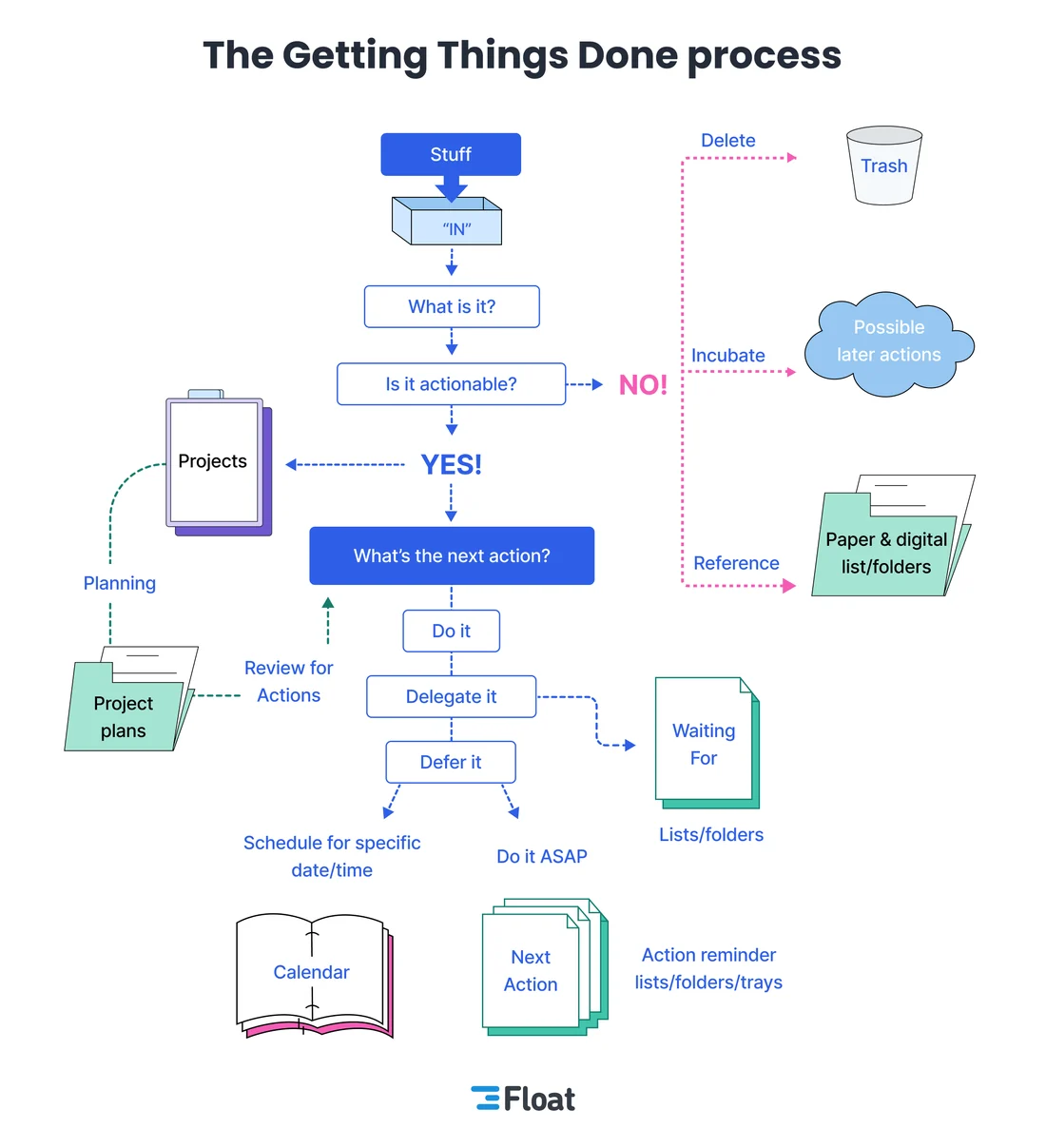
A method defined by five verbs
David Allen's Getting Things Done sets out five stages for handling anything that has your attention: capture, clarify, organize, reflect and engage. The method's own description puts it plainly: capture means collecting what demands focus, clarify means deciding whether an item is actionable and what the next step is, organize means storing the resulting reminders where they belong, reflect means reviewing the system often enough to trust it, and engage means acting from that system with confidence. A library catalogue record for the first edition, Getting Things Done: The Art of Stress-Free Productivity, lists 4 January 2001 as the publication date, from Viking. The book's central claim, repeated on the method's own site, is that your mind is for having ideas, not holding them — attention is wasted rehearsing commitments rather than acting on them.
Who the five steps are for
GTD is aimed at anyone whose work arrives as a stream of open loops: emails, requests, half-formed projects, things promised in a meeting. The mechanism is a trusted external system, not a particular app: an inbox for capture, lists organized by context or project, and a scheduled review that keeps the lists honest. The method's own site, as retrieved on 16 September 2026, says it has introduced the approach to 'over 2 million people' and sells the practice through Certified Trainers, coaching, a paid community called GTD Connect, and a self-assessment called GTD-Q. That commercial infrastructure exists because the hard part of GTD is not the vocabulary, it is doing the clarify and reflect steps consistently, week after week, without a coach or a deadline forcing the habit.
What is claimed and what is not shown
Neither of the method's own pages cites an independent study measuring whether GTD reduces stress or increases output; the 'stress-free' framing is the method's own tagline, not a measured result, and this draft found no peer-reviewed evaluation to cite alongside it. That gap matters when a tool vendor borrows GTD's vocabulary. Task managers happily add 'contexts' and 'next actions' as fields, but a field is not a habit: software can hold an infinite backlog without ever forcing the weekly reflect step that keeps the list trustworthy. Some apps add automatic reminders or recurring review prompts, which help; many simply let capture balloon past the point where clarify can keep up, which is closer to what the method warns against than what it recommends.
- Does the tool make the weekly review easier, or just make the backlog easier to ignore?
- Can you tell, at a glance, the very next physical action on a project rather than only its name?
- Who reviews the system when the habit lapses, and what brings it back?
GTD is a set of named habits before it is a piece of software. A tool earns the name only if it makes capture, clarify, organize, reflect and engage easier to do together, not just easier to store.
Sources & reading trail
Defines the five GTD steps — capture, clarify, organize, reflect, engage — in the method's own words.
Source published: Not established · Retrieved: 16 September 2026
States the method's claimed reach ('over 2 million people'), David Allen's core principle, and the paid training, coaching and GTD Connect infrastructure.
Source published: Not established · Retrieved: 16 September 2026
Records the first edition's publication date, 4 January 2001, and its publisher, Viking.
Source published: Not established · Retrieved: 16 September 2026
Announcements and papers establish the record; the friction reading and the adoption questions are Productivity Atlas editorial analysis. This retrospective draft does not imply the site published on the event date.