
From a Startup Weekend win to a public launch
Zapier's origin is documented not through an easily found page of its own from this period, but through a contemporaneous Silicon Prairie News report published on 20 June 2012, the day the report describes the product's formal public launch. The article traces founders Wade Foster, Bryan Helmig and Mike Knoop from winning a Startup Weekend competition in Columbia, Missouri in October 2011, through a private beta that November, to each founder leaving other jobs between December 2011 and May 2012 as the product gained traction, then relocating to Mountain View for Y Combinator ahead of the public release. At launch, the report states, the service connected more than 60 apps and already had 1,000 active users from its quiet beta.
Mapping fields instead of writing code
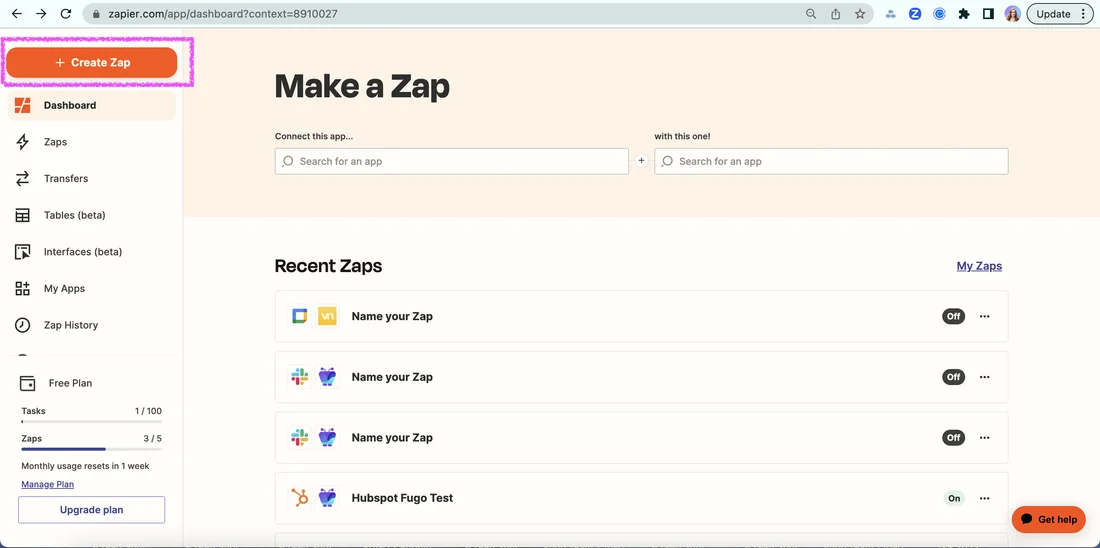
The mechanism a Zap automates is a field mapping between two applications: a trigger in one app, such as a new form submission, populates fields in another, such as a new row in a spreadsheet, without either application needing custom code written against the other's programming interface. Zapier's own help centre, retrieved 16 September 2026, still describes the product in this frame, now citing thousands of connected apps rather than the dozens named in 2012. Foster is quoted in the 2012 report describing it as an easy way for non-developers to get integrations between all their SaaS applications, a description that has held even as the number of possible integrations grew by roughly two orders of magnitude.
The cost of a chain nobody remembers building
Turning integration into a non-developer task also means a non-developer is the one maintaining it later, and a Zap that breaks when a connected app changes its structure fails in a way its builder may not be equipped to diagnose. Zapier's own about page frames the company's purpose as making computers do more work, which describes the goal without addressing what happens when an automated chain quietly stops running and nobody notices for weeks, because the whole point of automating it was to stop paying attention.
Questions to ask before you adopt it
- Who will notice, and how quickly, if this automation silently stops working?
- Does the plan you are on meet the volume of tasks you actually expect to run each month?
- What is the manual fallback if a connected app changes its data structure?
Zapier's 2012 launch made point-to-point integration a task anyone could set up in an afternoon. It did not remove the ongoing work of keeping that integration correct, only moved who is responsible for it.
Sources & reading trail
Zapier's own help centre describes the Zap mechanism and current app count as a living document.
Source published: Not established · Retrieved: 16 September 2026
Company's own about page states its mission of automating repetitive work.
Source published: Not established · Retrieved: 16 September 2026
Contemporaneous local report, used as a labelled secondary source, dates the founders' path from Startup Weekend to the 20 June 2012 public launch and describes the original feature set.
Source published: 20 June 2012 · Retrieved: 16 September 2026
Announcements and papers establish the record; the friction reading and the adoption questions are Productivity Atlas editorial analysis. This retrospective draft does not imply the site published on the event date.