
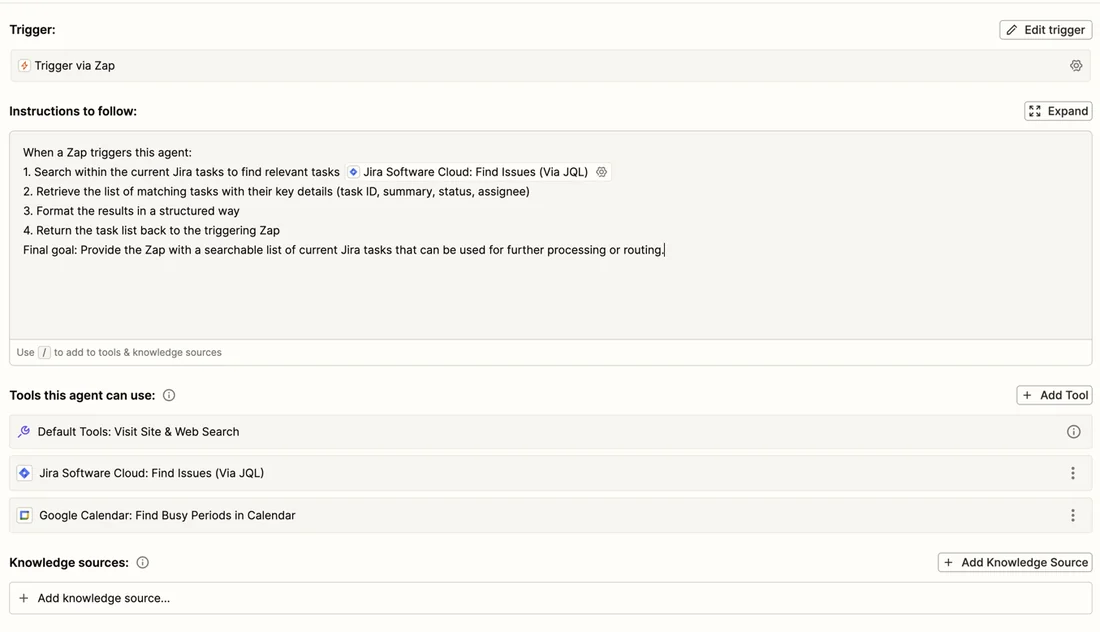
Two dated steps toward autonomous assistants
Zapier's move from workflow triggers toward standing assistants happened in stages rather than a single launch. The company's post on a Chrome extension for Zapier Central, published 13 June 2024, describes Central as letting a person 'train your AI bots on live data' and 'set up behaviors for your bot to perform' across thousands of connected apps — the company's own description of the product at that stage, pitched as 'the closest you can get to sending friendly AI bots to do your bidding'. Zapier's original March 2024 preview announcement for Central could not be located at its hinted address, so this account rests on that later, dated post rather than the first one. The company's fuller successor, Zapier AI Agents, was announced 22 January 2025, described as programs that 'access your business data, work in all your favorite apps, and handle tasks whether you're there or not'.
What the announcements say an agent does
Both products are described as operating across a large number of connected apps — the current agents product page cites '9,000+ apps' — for tasks such as lead enrichment, drafting replies and research, working 'on command and while you sleep'. That phrase is doing real work: it frames the product's value as not needing a person present while it acts, which is a different claim from a workflow that only runs when triggered by an event a person set up in advance.
Where human approval actually sits
Across the announcement posts and the current agents product page, none of the primary sources describes a mandatory step where a person confirms an individual action before it runs. The closest documented mechanism is described as the ability to 'monitor activity' and 'chat when needed' — oversight that happens by checking in on what an agent already did, not by approving what it is about to do. Zapier's own current help centre also shows the product itself is still moving: it lists a guide for 'migrating from Agents to AI by Zapier', evidence that the name and shape of this feature keep changing even as the underlying idea of an autonomous assistant continues.
- Is there a step where a person approves a specific action before an agent takes it, or only a log of what already happened?
- Which connected apps can an agent act on directly, and which require a human to complete the action?
- Has the feature been renamed or restructured since a given announcement, in a way that changes what it still does?
An automation that runs only when triggered and an assistant that acts while a person sleeps are different commitments of trust. The vendor's own material describes the second without describing, in the same detail, a corresponding pre-action check.
Sources & reading trail
Describes Zapier Central as letting a user train AI bots on live data and configure behaviors across connected apps. Substituted for the hinted zapier.com/blog/zapier-central/ URL, which now 404s and could not be relocated.
Source published: 13 June 2024 · Retrieved: 16 September 2026
Announces Zapier AI Agents on 22 January 2025 and describes them as working across connected apps whether or not a person is present.
Source published: 22 January 2025 · Retrieved: 16 September 2026
Living page stating agents work across 9,000+ apps and describing monitoring and chat as the oversight mechanism, with no mention of pre-action approval.
Source published: Not established · Retrieved: 16 September 2026
Living help-centre page listing a guide for migrating from Agents to AI by Zapier, showing the product has since been restructured. Substituted for the hinted help.zapier.com section URL, which 404s.
Source published: Not established · Retrieved: 16 September 2026
Announcements and papers establish the record; the friction reading and the adoption questions are Productivity Atlas editorial analysis. This retrospective draft does not imply the site published on the event date.