
A prototype called Trellis becomes a launch
Trello's own history, published on its about page and retrieved 16 September 2026, dates the product to a Fog Creek Software exploration week in the summer of 2010, when a prototype called Trellis was built to help with high-level planning. Fog Creek pitched the idea more formally in January 2011, and the company's account states that the renamed product, Trello, launched with web and iPhone apps at TechCrunch Disrupt in September 2011. Names considered and rejected along the way, according to the same page, included Cardvark and Planatee. This is a vendor's own retrospective account rather than a contemporaneous press release, so treat the sequence as Trello's self-told history rather than an independently audited timeline.
What a board actually represents
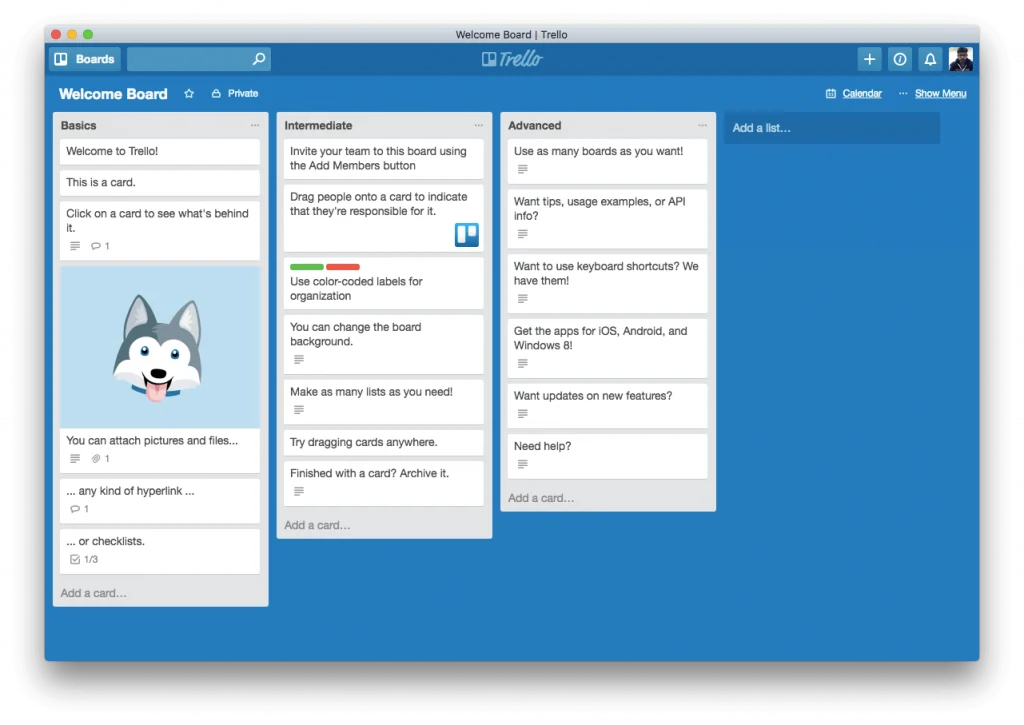
Trello's own guide describes a board as a place to keep track of information for a project, team or workflow, with lists holding cards that move through stages of progress. The guide is explicit that there is no limit to the number of lists or cards on a board. That flexibility is the product's whole pitch: a board makes columns and cards visible to anyone who opens it, which a private to-do list does not. It is a shared, spatial view of work rather than a personal record of tasks to complete.
What a board does not do
The same flexibility is also the friction. A board shows where a card sits, not why it has been sitting there for three weeks, and Trello's guide does not claim otherwise: it markets scale and openness, not accountability. Unlike a personal task list with due dates built into its structure, a board's columns mean whatever the team decides they mean, which has to be agreed and maintained by someone or the board drifts out of sync with the actual work. The company's account notes 500,000 members within a year of launch and a 2014 spin-off from Fog Creek into an independent company before Atlassian's 2017 acquisition, growth that says more about adoption than about whether any individual board stayed accurate.
Questions to ask before you adopt it
- Who is responsible for moving cards between columns, and what happens when nobody does?
- Does the board need due dates and owners added on top of the card, or does the column alone suffice?
- What did the tool's own launch materials claim it replaces, and is that the problem your team actually has?
A board is a visualisation, not a management system. Trello's own history shows a fast path from an internal prototype to a mainstream product; it says far less about what keeps a board honest once the launch novelty wears off.
Sources & reading trail
Company's own history page dates the public launch to TechCrunch Disrupt in September 2011 and describes the Fog Creek Software origin and later spin-off and acquisition.
Source published: Not established · Retrieved: 16 September 2026
Living guide describing what boards, lists and cards are for and their lack of a built-in limit.
Source published: Not established · Retrieved: 16 September 2026
Announcements and papers establish the record; the friction reading and the adoption questions are Productivity Atlas editorial analysis. This retrospective draft does not imply the site published on the event date.