
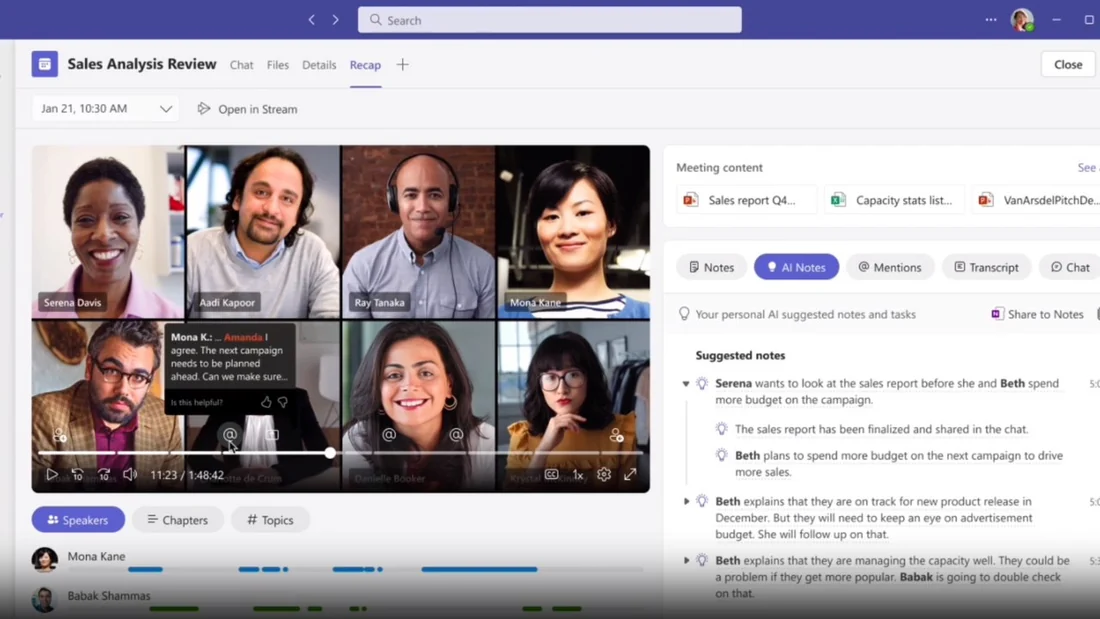
What a standard recap becomes with Intelligent Recap
Microsoft's support documentation on meeting recap describes a standard Teams recap as the recording, transcript, shared files, agenda and any manually-added notes and tasks tied to a meeting. Intelligent Recap adds AI-generated notes and tasks, a speaker timeline marking who spoke and when, and markers showing when a person's name was mentioned. The documentation is explicit about the input: “Teams uses the event transcript, attendance data, and PPT Live data” to produce these AI features, meaning the output only exists, and is only as complete, as whatever the transcription and attendance tracking captured during the meeting itself.
Who gets it, and what they are told about accuracy
Microsoft's Teams Premium admin documentation states that Intelligent Recap, for both meetings and one-to-one calls, requires a Teams Premium licence or a Microsoft Copilot licence, on top of an ordinary Teams licence, and that an organiser must have transcription switched on in their meeting policy or the feature is unavailable regardless of licence. The support article carries its own warning in plain language: “AI-generated content is based on the event transcript and is powered by GPT and other AI models. Some AI-generated content might be inaccurate, incomplete, or inappropriate.” That sentence, printed by Microsoft itself rather than added by a critic, is the clearest statement available of what the feature is not.
A draft standing in for meeting minutes
The practical risk is not that the recap looks unfinished; it is the opposite: a generated action-item list and speaker timeline look complete and can read as an official record even though nothing in Microsoft's own documentation claims it has been checked against what actually happened. Meetings lasting less than five minutes, or in a language the transcription does not support, do not get AI notes at all, a limitation easy to miss until a short but important call produces no recap. Access is also restricted to invited participants inside the organisation, so a shared recap needs a separate decision about wider distribution.
Questions to ask before you adopt it
- Is transcription actually enabled for the meetings your team most needs recapped?
- Who compares an AI-generated action item list against the discussion before it is treated as an assignment?
- Does the recap's audience match who was actually in the meeting, given its access restrictions?
Microsoft's documentation gives Intelligent Recap a plain job description and a plain warning in the same set of pages: useful notes generated from an imperfect transcript, not a substitute for someone confirming what was actually agreed.
Sources & reading trail
Describes what standard recap and Intelligent Recap generate, the transcript/attendance/PPT Live data they use, and Microsoft's own inaccuracy caveat.
Source published: Not established · Retrieved: 16 September 2026
States Intelligent Recap requires a Teams Premium or Microsoft Copilot licence on top of a Teams licence, and that transcription must be enabled.
Source published: Not established · Retrieved: 16 September 2026
Announcements and papers establish the record; the friction reading and the adoption questions are Productivity Atlas editorial analysis. This retrospective draft does not imply the site published on the event date.