
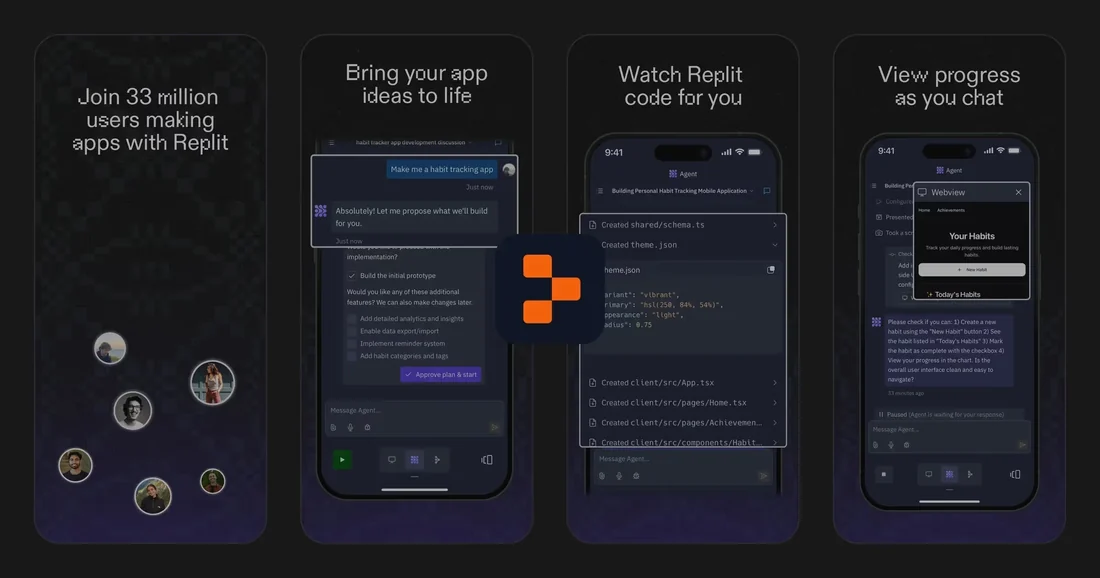
An announcement dated 16 September 2024
Replit announced Replit Agent on 16 September 2024, describing it as 'an AI system that can create and deploy applications' that 'configures your development environment, installs dependencies, and executes code'. The post's central claim is speed and reach: taking an application 'from idea to deployment' with 'a few sentences and a few minutes', aimed explicitly beyond professional developers at 'Founders', 'Product Managers', 'Designers' and 'Operations' roles, with examples including a doctor deploying a health dashboard. Access required a 'Replit Core' subscription, and the Agent was described as being in 'early access' at launch — a stage the announcement itself flags as provisional, not a finished product.
What a non-developer gets, per the documentation
Replit's current documentation describes the Agent writing code, setting up infrastructure and testing the result 'without requiring coding knowledge'. Replit's product page adds that a built project connects to real services, including databases, authentication and third-party tools such as Stripe, with 'no coding experience required'. The safety mechanism named is not a review step but a rollback: the Agent 'creates checkpoints as it works, so you can roll back to any previous state', and a user who dislikes a result is expected to 'chat with Agent to describe what went wrong' rather than read and fix the code directly. The person decides when to 'publish when you're ready' — that publishing decision is the one clear approval point the documentation describes, sitting after the building, not before each change inside it.
What is inherited once the agent stops
Neither the announcement nor the documentation states what a project costs to keep running, how it is maintained once early access ends, or what happens when a connected service such as a payment or authentication provider needs updating later — the primary sources describe building and publishing an application, not owning one over time. A non-technical founder who cannot read the generated code has, once it is published, a live application wired to real accounts and data, with checkpoints as the only stated way back to an earlier state. That is a materially different position from a developer using the same tool: rollback assumes a working prior checkpoint, not an understanding of why the current version broke, and the documents do not describe what happens once checkpoints themselves run out or an integration changes independently of Replit.
- Who is responsible for the application once the Agent's early-access session ends: the person who described it, or nobody in particular?
- Does 'rolling back to a checkpoint' fix an underlying problem, or only undo the most recent attempt at one?
- Can the person who requested the app read or verify what it does with the accounts and data it now touches?
Describing an app into existence is a genuine capability change for people without coding skills. What the primary sources do not resolve is who does the ordinary work of running that app, once the sentence that created it is no longer the point.
Sources & reading trail
Announces Replit Agent on 16 September 2024, states its target audience beyond professional developers, and that it required a Replit Core subscription during early access. Substituted the redirected replit.com/blog URL for the original blog.replit.com hint.
Source published: 16 September 2024 · Retrieved: 16 September 2026
Living documentation describing checkpoints as the rollback mechanism and publishing as the point where a person approves the result.
Source published: Not established · Retrieved: 16 September 2026
States the product requires no coding experience and connects to databases, authentication and third-party services such as Stripe.
Source published: Not established · Retrieved: 16 September 2026
Announcements and papers establish the record; the friction reading and the adoption questions are Productivity Atlas editorial analysis. This retrospective draft does not imply the site published on the event date.