
A public preview announced on 22 August 2023
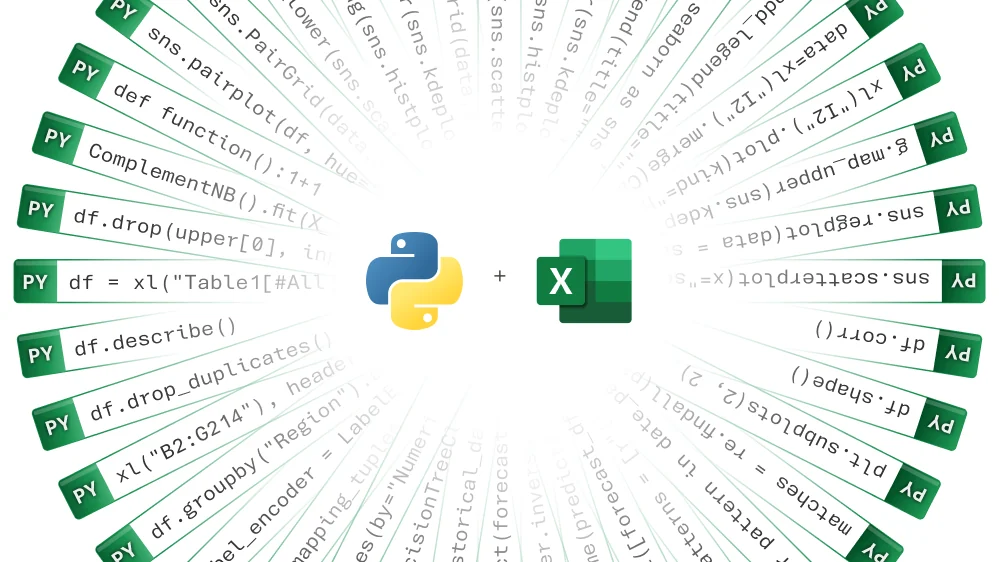
Microsoft's Excel blog announcement opened a public preview of Python in Excel to Microsoft 365 Insiders running the Beta Channel of Excel for Windows on 22 August 2023. The mechanism is a worksheet function, =PY(), into which a person types Python rather than a formula. The announcement states the feature ships with a core set of libraries from Anaconda, including pandas, Matplotlib, seaborn and scikit-learn, so a workbook can clean data, fit a model or draw a chart without installing anything locally. Guido van Rossum, credited in the post as a Microsoft engineer who helped define the feature's architecture, is quoted welcoming the integration; that quote is a participant's reaction, not an independent assessment of how well it works.
Where the code actually runs
The distinguishing claim in the announcement is not the language support but the location of execution. Microsoft states that Python calculations run in the Microsoft Cloud inside a hypervisor-isolated container built with Azure Container Instances, using packages sourced through Anaconda's own supply chain. Data reaches the code only through a companion function, xl(), and results return only as the output of =PY(); the running code is described as unable to identify the user. This is a different model from a macro or an add-in that executes on the machine that opens the file. It also means a workbook containing Python can be handed to a colleague, and, per Microsoft's support documentation, they can refresh the analysis without installing Python, a runtime, or any of the libraries the original author used.
What the announcement does not resolve
The support page is explicit about one requirement that is easy to miss: Python in Excel needs internet access, because the calculation itself happens off the machine. It is also not available in Excel on iPad, iPhone or Android, and it requires a qualifying Microsoft 365 subscription, with a separate optional add-on licence for faster, premium compute. None of this appears in the announcement itself; it is documented only in the support article's fine print. A workbook that depends on Python in Excel will not open the same way for a colleague on a personal Microsoft account, on mobile, or offline, a real constraint for a supposedly ordinary Excel file. Whether the isolation model is as strong as described also remains, by nature, a vendor claim rather than something a reader can verify directly.
- Does everyone who needs to open this workbook have a qualifying Microsoft 365 subscription and internet access?
- Does the analysis need to run on a phone or tablet, where Python in Excel is not available?
- Is the workbook's data sensitive enough that running it in a Microsoft-hosted container, rather than locally, needs sign-off first?
Python in Excel is a genuine change in what a spreadsheet can compute, but the interesting design decision is not the language, it is the decision to run that language somewhere else entirely. That trade-off, convenience in exchange for a dependency on connectivity, licensing and a remote container, is the part worth reading past the demonstration.
Sources & reading trail
States the public preview date, the container-based execution model and the included Anaconda libraries.
Source published: 22 August 2023 · Retrieved: 16 September 2026
Living documentation establishing the internet-access requirement, licensing and platform limitations.
Source published: Not established · Retrieved: 16 September 2026
Announcements and papers establish the record; the friction reading and the adoption questions are Productivity Atlas editorial analysis. This retrospective draft does not imply the site published on the event date.