
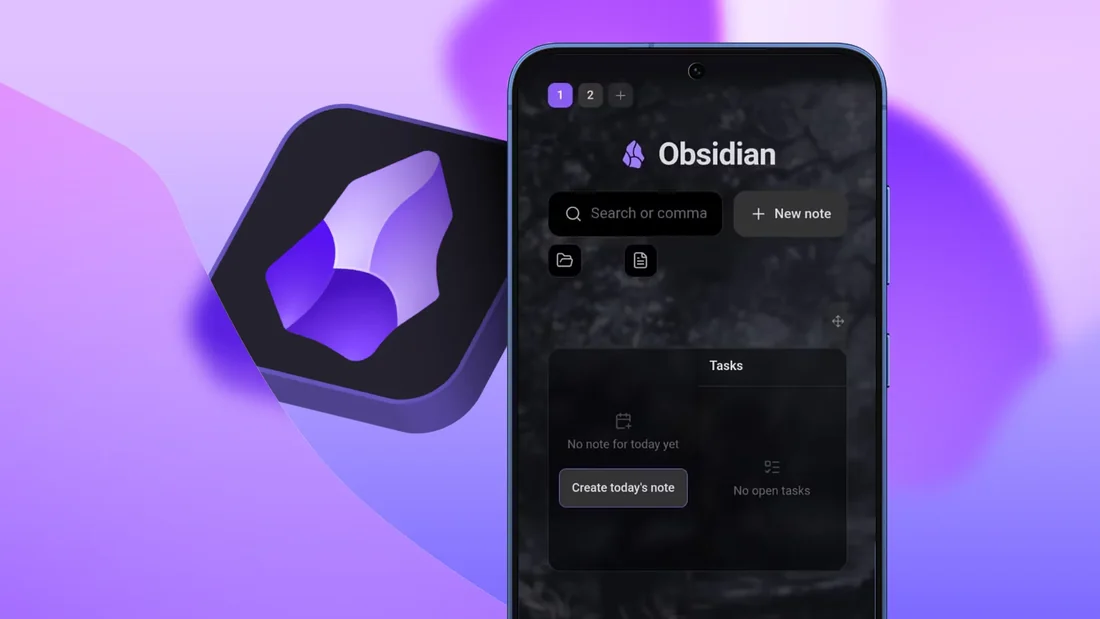
A note-taking app that starts from a folder
Obsidian's own account of its origin, on its about page, states that its founder “started Obsidian in 2020 to build the perfect note-taking app” for her own notes; the page gives no more specific date than the year. What it built around that starting point is a design choice that distinguishes Obsidian from most cloud note apps: the product page states that Obsidian “stores notes privately on your device” and “uses open file formats, so you're never locked in.” In practice this means a vault of notes is a folder of plain Markdown text files that any text editor, not just Obsidian, can open.
What that buys, and what still has to be built on top
A folder of local text files is durable in a specific sense: it does not depend on a company's servers staying online, and it can be backed up, version-controlled or read by other software without a separate export step. But a folder on one device is not, by itself, available on a phone or a second computer, and Obsidian's own documentation hub is explicit that syncing across devices is not automatically part of the free product: it describes a paid add-on, Obsidian Sync, as “a safe and secure way to synchronise your notes across any device and OS,” alongside a separate option, Obsidian Publish, for sharing notes as web pages. The same documentation describes an ecosystem of “thousands of plugins and themes,” split between built-in “core plugins” that can be toggled on or off and community plugins written by users, which is how most of Obsidian's more advanced features, from graph views to task management, are actually delivered.
The convenience local-first gives up
None of this is free of trade-offs, and describing it otherwise would be uncritical marketing rather than analysis. A plain-file, plugin-extended system has no single vendor responsible for making sync, backup or mobile access work out of the box; a user who wants those things either pays for Obsidian's own service, wires up a third-party sync tool such as a cloud-synced folder or version control, or accepts that their notes live on one machine. Community plugins, by definition, are not written or vetted by Obsidian itself, so relying on one for a core workflow is a smaller-scale version of the same dependency problem this batch documents in company-run tools, just distributed across many individual plugin authors instead of one vendor.
- If Obsidian disappeared tomorrow, could you still open and read every note using only the files on disk?
- Which parts of your workflow depend on a community plugin rather than on a core, Obsidian-maintained feature?
- Have you set up cross-device sync deliberately, whether paid or self-managed, or are your notes actually only on one machine?
Local-first is a genuine answer to the dependency question this batch keeps raising, but it answers only the data-portability part of it; sync, plugins and long-term maintenance still rest on a mix of a small company and its volunteer plugin authors, and that is worth knowing before treating a local vault as maintenance-free.
Sources & reading trail
Living product page stating the local-storage and open-file-format design and the encrypted, selective sync model.
Source published: Not established · Retrieved: 16 September 2026
Living documentation hub describing core versus community plugins and the paid Obsidian Sync and Publish add-ons.
Source published: Not established · Retrieved: 16 September 2026
States the project was started in 2020, without a specific month or day.
Source published: Not established · Retrieved: 16 September 2026
Announcements and papers establish the record; the friction reading and the adoption questions are Productivity Atlas editorial analysis. This retrospective draft does not imply the site published on the event date.