
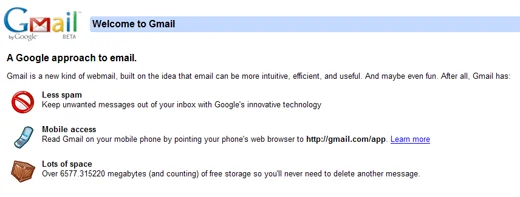
A storage number designed to end a chore
On 1 April 2004, Google announced Gmail with a headline number: the announcement promised each user 1 gigabyte of storage, described as more than 100 times the roughly four-megabyte allowance most free webmail services offered at the time. The pitch was not a new interface so much as a new arithmetic: if storage was abundant, the daily task of deleting old mail to make room for new mail could simply stop. Larry Page and Sergey Brin were quoted in the announcement praising the product's speed and its availability from anywhere, framing Gmail as solving Google's own communication problem before it solved anyone else's.
Search as the organising principle
The announcement leaned on Google's search technology to locate messages rather than asking users to build folder structures in advance. That is a specific, testable claim: instead of filing a message into a category at the moment it arrives, a Gmail user could leave it in a single pile and rely on retrieval later. Google's current search-operator documentation shows how far that idea has been built out, retrieved 16 September 2026: operators for sender, subject, date range, label and attachment status let a search stand in for what would otherwise be a folder tree. The 2004 promise and the 2026 help page describe the same underlying bet, more than two decades apart.
What the abundance model does not solve
A gigabyte in 2004 was generous; it is no longer the number that matters. Google's own storage guidance now describes a shared allowance across Gmail, Drive and Photos rather than a dedicated mail quota, which changes the calculation: mail competes with photo backups and documents for the same ceiling. Search also carries a cost the 2004 launch did not have to mention, because there was so little to search yet: a large, unfiled inbox is only as useful as the query someone remembers to write, and search cannot resurface a message whose relevant words were never typed into it. Abundant storage removed one form of labour, filing, and quietly introduced another, recall.
Questions to ask before you adopt it
- Does the tool's storage allowance apply to one product, or is it shared across several services you also use?
- If you cannot recall the right search term, what is your fallback for finding a specific message?
- What happens to your archive if the provider changes the terms of a free allowance later?
Gmail's real innovation in 2004 was not email; it was a bet that search would beat filing at scale. That bet still needs a person willing to search, rather than someone who reads every message once and never touches it again.
Sources & reading trail
Google's own 2004 press release states the 1GB storage figure, compares it with rivals' roughly four-megabyte limits, and quotes Larry Page and Sergey Brin on the product's aims.
Source published: 1 April 2004 · Retrieved: 16 September 2026
Google's current help-centre documentation, as a living document, describes the search operators that let a user retrieve mail instead of filing it.
Source published: Not established · Retrieved: 16 September 2026
Announcements and papers establish the record; the friction reading and the adoption questions are Productivity Atlas editorial analysis. This retrospective draft does not imply the site published on the event date.