
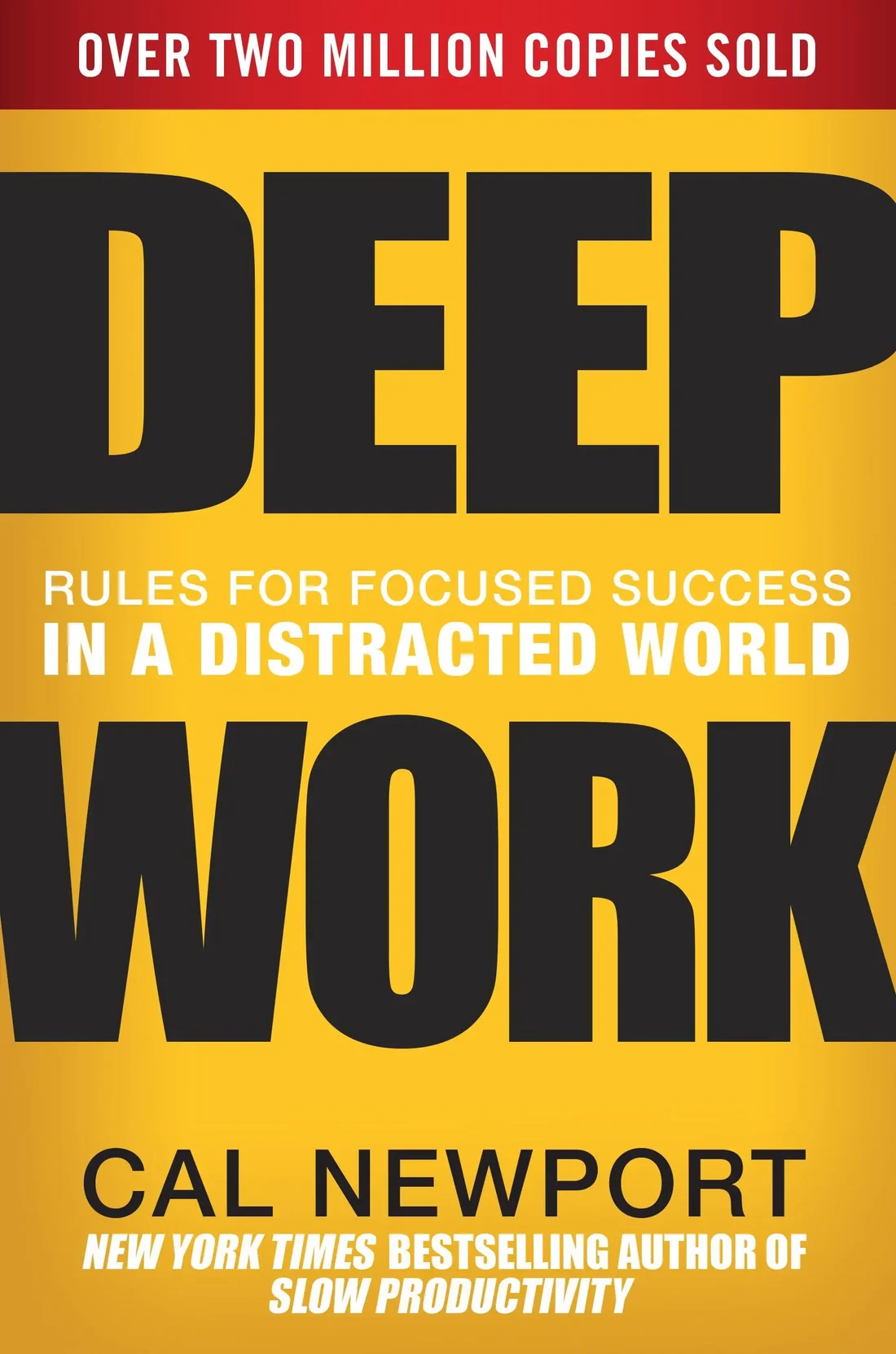
A book that names focus as a skill, dated 5 January 2016
Cal Newport's Deep Work: Rules for Focused Success in a Distracted World was published on 5 January 2016 by Grand Central Publishing, according to the publisher's own listing, which states its central claim directly: 'Deep Work — the ability to focus without distraction on cognitively demanding tasks — is one of the most important abilities you can cultivate in our current moment.' Newport's own site, as retrieved on 16 September 2026, places the book in a self-described 'Technology and Society trilogy' and notes it has sold more than 1.5 million copies — a measure of reach, not of whether the method works, and it is the author's own figure rather than an independently audited sales report.
Four rules, and who they assume
The publisher's description lists four rules the book builds around: work deeply, embrace boredom, quit social media, and drain the shallows. In practice this describes scheduling long, single-task blocks of time — hours rather than minutes — protected from email, chat and meetings, on the argument that switching tasks fragments the concentration cognitively demanding work requires. That assumes a job where blocks of that length are available to schedule at all; it fits research, writing or engineering roles with discretion over their own calendar far better than roles built around responding to other people on demand, a distinction the publisher's page does not raise.
What the interruption evidence actually shows
The book's argument rests on distraction being costly, and one controlled study gives evidence for a version of that claim without proving Newport's stronger case. Mark, Gudith and Klocke's 2008 experiment interrupted 48 subjects performing an email task roughly every two minutes, compared with an uninterrupted baseline. The interrupted groups did not take longer or make more errors — they finished faster — but they reported significantly higher stress, frustration, time pressure and effort. That is real evidence that interruption carries a cost, but the cost measured was subjective strain over a 20-minute task, not a demonstrated loss of the deeper cognitive capacity the book describes over hours of work. Nothing in that study measures 'depth,' and the book's own claims about rare, high-value cognitive output are Newport's argument, not a tested result.
- Does your role actually allow multi-hour blocks free of requests from other people?
- Is a scheduling tool enforcing the block, or only recording that one was planned?
- What is being measured as 'deep' work: hours booked, or output produced?
The book names a real and plausible cost — fragmented attention — and evidence exists for a cost of that general kind. Whether protecting hours produces the specific value the book promises is a claim the reader is still being asked to take on trust.
Sources & reading trail
Publisher record gives the 5 January 2016 publication date and the book's own central claim and four rules.
Source published: Not established · Retrieved: 16 September 2026
Author's own page frames the book within a 'Technology and Society trilogy' and states a claimed sales figure.
Source published: Not established · Retrieved: 16 September 2026
Controlled experiment measuring the subjective stress cost of interruption, distinct from the book's claims about cognitive depth.
Source published: Not established · Retrieved: 16 September 2026
Announcements and papers establish the record; the friction reading and the adoption questions are Productivity Atlas editorial analysis. This retrospective draft does not imply the site published on the event date.