
A link instead of an email thread
Calendly's company materials state that Tope Awotona founded the company in 2013 to eliminate back-and-forth scheduling emails. The product's central object is not a calendar but a link: a page a user shares that shows open blocks of time, built from the connected calendar's existing commitments. A recipient picks a slot; the system writes the meeting to both calendars without either party first writing to the other about times. That inversion, from asking when someone is free to publishing an answer in advance, is the entire pitch, and it is worth separating from the company's own account of why it built the product, which is a claim about motive rather than a measurement.
How the mechanism actually behaves
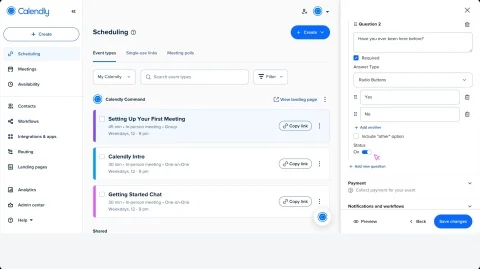
According to Calendly's help documentation, a link is generated from an event type: a bookable meeting template with a fixed duration, location and set of availability rules. Connecting a calendar, Google, Outlook or Exchange, lets Calendly check that calendar for busy times and add new meetings to it, so an invitee only ever sees genuinely open slots. Hosts can add buffer time before or after a meeting, cap how many bookings land in a day, week or month, and set the increment at which slots start. A troubleshooting tool exists specifically to explain why a given time is not offered, which suggests the availability logic is complex enough to need its own diagnostic layer.
What a link changes, and what it does not remove
A scheduling link does not remove negotiation from meetings; it moves the negotiation into rules set once, in advance, rather than a conversation held per meeting. That suits a host who takes many similar meetings and suits irregular ones less well, since fixed rules cannot anticipate every constraint. It also hands the invitee a form: they see availability as the host has configured it, not the host's actual state of mind about a particular week. A host who forgets to update a rule, a holiday, a conference, exposes slots that later have to be cancelled or rescheduled by hand. Because the link depends on a live calendar connection, an authentication failure or a permissions change can silently create false availability, a failure mode the documentation's own troubleshooting tool is a tacit admission of.
Questions to ask before you adopt it
- Do your meeting types repeat often enough that rules set in advance beat a one-off conversation about timing?
- What happens to invitees' trust in your calendar if a rule goes stale or a connected account loses access?
- Who can see or edit your availability rules, and does that match who should control your calendar?
The company's own account of its founding is a claim about motive, not an independent measurement of time saved. What the documentation verifies is the mechanism: a link reads a calendar, applies configured rules, and writes back a result. Judging it well means judging the rules a host sets, not only the convenience of the link itself.
Sources & reading trail
States the company was founded in 2013 by Tope Awotona and describes the product's aim of removing scheduling emails.
Source published: Not established · Retrieved: 16 September 2026
Documents the scheduling-link mechanism: calendar connection, busy-time checks, buffers, limits and troubleshooting.
Source published: Not established · Retrieved: 16 September 2026
Announcements and papers establish the record; the friction reading and the adoption questions are Productivity Atlas editorial analysis. This retrospective draft does not imply the site published on the event date.