
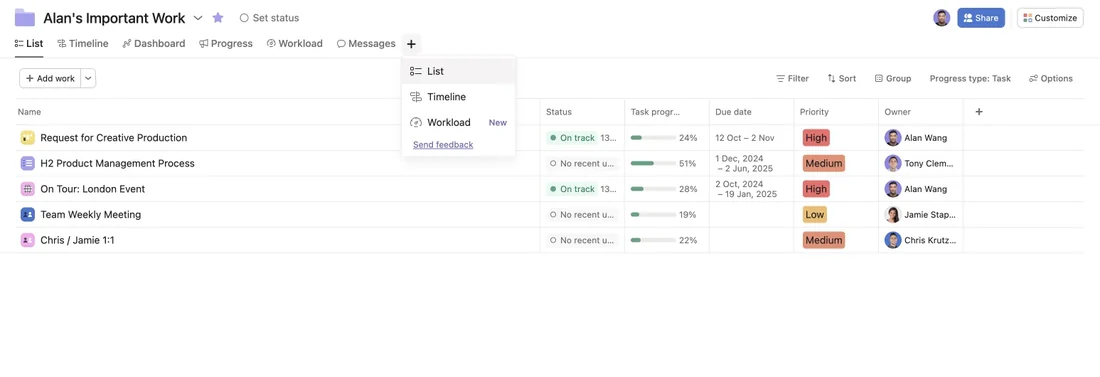
Named after a founders' shared frustration
Asana's own company page, retrieved 16 September 2026, traces the product to co-founders Dustin Moskovitz and Justin Rosenstein noticing, while both worked at Facebook, that talented people were spending more than half their day in meetings and chasing status updates rather than doing the work itself. The company's 2020 registration statement, filed for its direct stock market listing, records the legal starting point: the business was incorporated in December 2008 under the name Smiley Abstractions, Inc. Neither document states a public launch month. A contemporaneous TechCrunch report from April 2012, five months after the fact, states plainly that Asana launched in November 2011, and quotes co-founder Justin Rosenstein noting that in the first five months customers had created 10 million tasks and completed 4 million of them.
A shared record, not a private list
The distinguishing mechanism is ownership made visible to everyone on the team, not just the person doing the work: a task in Asana carries an assignee and a due date as structured data, not as text buried in a message. That is a different object from a personal to-do list, which only has to be legible to the one person keeping it. A personal list can stay messy and still function; a shared work-tracking tool has to be legible to people who did not write the tasks, which pushes a team toward agreeing on conventions, such as what counts as done, before the tool is useful at all.
The coordination the tool assumes, not creates
The 2012 usage numbers describe volume, not whether that volume replaced meetings or simply added a new record alongside them. A tool that tracks who owns what does not, by itself, resolve disagreement about priority; it only makes the current, possibly wrong, assignment visible to more people. Teams that adopt shared task tracking without first agreeing on how work gets prioritised often end up with a fully populated, mutually visible list that nobody trusts, a different failure from the one the tool claims to fix.
Questions to ask before you adopt it
- Does everyone agree on what counts as done, or will the same status mean different things to different people?
- Who is responsible for closing out stale tasks that no longer matter?
- Is the tool replacing a status meeting, or simply adding a new place status has to be reported?
Asana's launch made task ownership a shared, structured fact rather than a private note. Whether that visibility improves coordination depends on habits the tool cannot supply on its own.
Sources & reading trail
Company's own page describes the founding story of Moskovitz and Rosenstein's experience of work about work at Facebook.
Source published: Not established · Retrieved: 16 September 2026
2020 registration statement records Asana's December 2008 incorporation as Smiley Abstractions, Inc.
Source published: 24 August 2020 · Retrieved: 16 September 2026
Contemporaneous TechCrunch report, used as a labelled secondary source, states Asana launched in November 2011 and quotes co-founder Justin Rosenstein on early task volume.
Source published: 21 April 2012 · Retrieved: 16 September 2026
Announcements and papers establish the record; the friction reading and the adoption questions are Productivity Atlas editorial analysis. This retrospective draft does not imply the site published on the event date.